
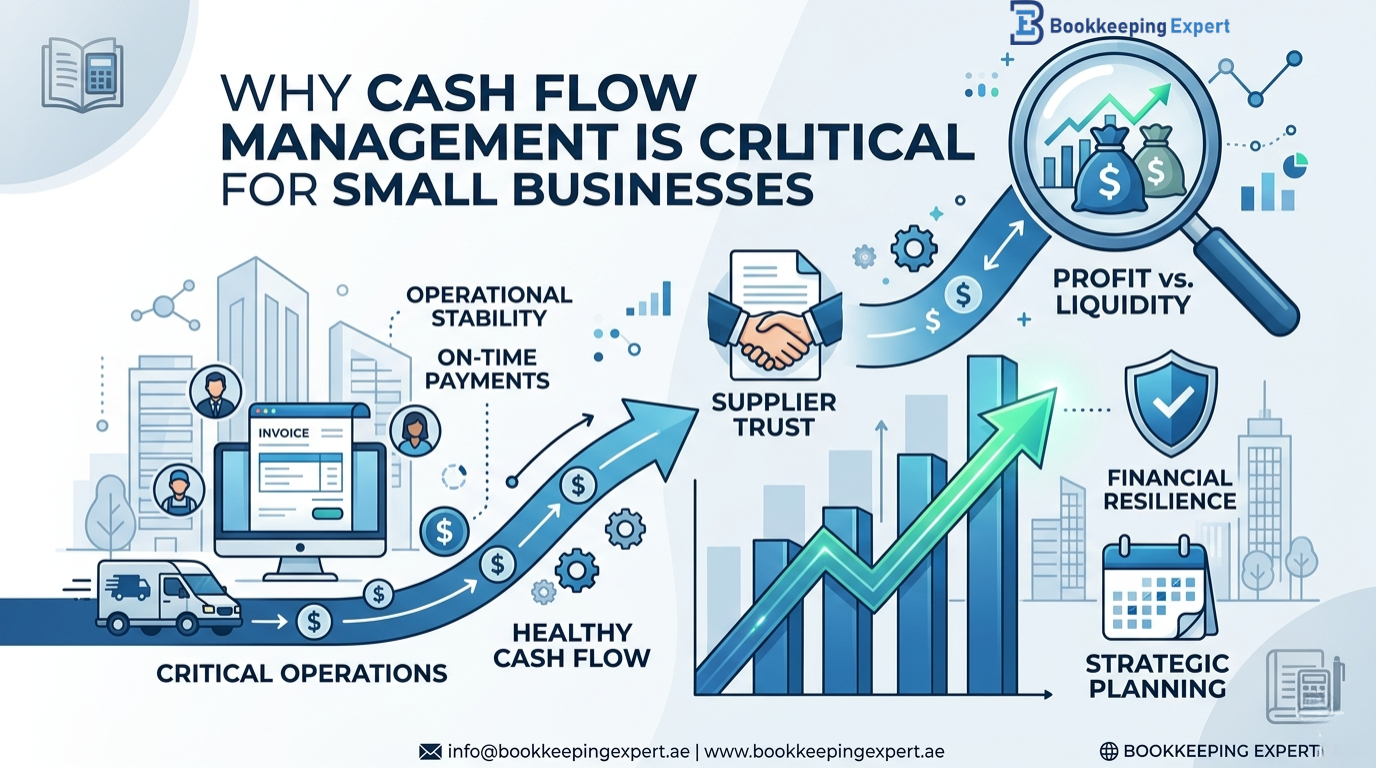
For small businesses, success is rarely just about profit—it’s about timing. You can be profitable on paper and still struggle to pay salaries, suppliers, or rent. That gap between money coming in and money going out is what we call cash flow, and managing it effectively is what keeps a business alive.
Cash flow is not just a financial metric—it is the heartbeat of your business operations. Without proper control, even promising businesses can face sudden financial distress.
Let’s explore why cash flow management is absolutely critical for small businesses and how it directly impacts survival and growth.
1. Cash Flow Keeps Daily Operations Running
Small businesses rely heavily on consistent cash availability to function smoothly. From paying employees to purchasing inventory, every operational activity depends on cash in hand.
Poor cash flow management can lead to:
-
Delayed salary payments
-
Missed supplier deadlines
-
Interrupted operations
-
Loss of customer trust
Even short-term disruptions can create long-term damage.
2. Profit Does Not Equal Cash Availability
One of the most common misconceptions among business owners is assuming profit means liquidity. However, profit is an accounting figure, while cash flow reflects real money available.
A business can be profitable but still face cash shortages due to:
-
Delayed customer payments
-
High credit sales
-
Large upfront expenses
-
Poor collection cycles
Understanding this difference is essential for financial survival.
3. Helps Avoid Debt Dependency
When cash flow is poorly managed, businesses often rely on loans or credit to stay afloat. While borrowing can support growth, excessive dependency becomes risky.
Strong cash flow management helps:
-
Reduce unnecessary borrowing
-
Avoid high-interest debt cycles
-
Maintain financial independence
-
Improve creditworthiness
Healthy cash flow means fewer financial emergencies.
4. Enables Better Business Decision-Making
Cash flow clarity allows business owners to make informed and confident decisions. Without it, decisions are often based on assumptions.
With proper management, you can:
-
Time investments effectively
-
Plan expansions safely
-
Control expenses strategically
-
Identify financial risks early
It turns uncertainty into clarity.
5. Supports Growth and Expansion
Growth requires investment—whether in inventory, marketing, staff, or infrastructure. Without stable cash flow, scaling becomes risky.
Good cash flow management helps businesses:
-
Invest at the right time
-
Avoid overextending resources
-
Maintain operational balance during expansion
-
Support sustainable growth strategies
Growth without cash control often leads to failure.
6. Builds Strong Supplier and Vendor Relationships
Timely payments are critical for maintaining trust with suppliers. Poor cash flow can damage these relationships and disrupt supply chains.
Effective cash flow ensures:
-
On-time payments
-
Better negotiation power
-
Stronger long-term partnerships
-
Priority service from vendors
Good relationships often translate into better business terms.
7. Improves Financial Stability During Uncertainty
Markets fluctuate, and unexpected challenges can arise at any time. Businesses with strong cash flow management are better prepared to handle uncertainty.
It helps you:
-
Maintain operations during downturns
-
Handle unexpected expenses
-
Adapt to market changes
-
Stay financially resilient
Cash reserves act as a safety buffer.
8. Enhances Budgeting and Forecasting Accuracy
Cash flow data provides real insight into financial patterns. This makes budgeting and forecasting more reliable and realistic.
It supports:
-
Accurate expense planning
-
Revenue forecasting
-
Seasonal cash planning
-
Long-term financial strategy
Better forecasting leads to fewer financial surprises.
9. Reduces Stress and Financial Pressure
Financial uncertainty is one of the biggest stress factors for small business owners. Poor cash flow visibility only makes it worse.
When cash flow is well managed:
-
Financial stress reduces
-
Decision-making becomes easier
-
Confidence in operations increases
-
Business control improves
Clarity brings peace of mind.
10. Strengthens Long-Term Business Survival
Many small businesses fail not because they are unprofitable, but because they run out of cash. Cash flow management is directly linked to business survival.
Strong cash flow ensures:
-
Continuous operations
-
Financial flexibility
-
Crisis preparedness
-
Long-term sustainability
It is the foundation of business longevity.
Final Thoughts
Cash flow management is not optional for small businesses—it is essential. It determines whether a business can survive daily operations, handle challenges, and grow sustainably.
While profit shows success on paper, cash flow ensures success in reality. Businesses that master cash flow management gain stability, confidence, and long-term control over their financial future.
