
In today’s competitive business landscape, companies are under constant pressure to operate efficiently while keeping operational costs under control. Financial management is one of the most critical parts of running a business, but maintaining a full in-house accounting department can be both time-consuming and expensive.
This is why many modern businesses are turning to outsourced accounting services. By delegating accounting responsibilities to external experts, companies can streamline financial operations, reduce expenses, and focus on what truly drives growth.
Outsourced accounting is no longer just a trend—it has become a strategic solution for businesses looking to maximize efficiency and profitability.
What Is Outsourced Accounting?
Outsourced accounting refers to hiring an external accounting service provider to manage financial tasks such as bookkeeping, financial reporting, payroll, tax preparation, and compliance.
Instead of employing a full internal accounting team, businesses collaborate with experienced professionals who handle financial processes remotely using advanced accounting tools and secure systems.
Common outsourced accounting services include:
-
Bookkeeping and financial record management
-
Accounts payable and receivable management
-
Payroll processing
-
Bank and credit card reconciliation
-
Financial reporting and analysis
-
Tax preparation and compliance support
This approach allows businesses to maintain accurate financial management without the high cost of internal staffing.
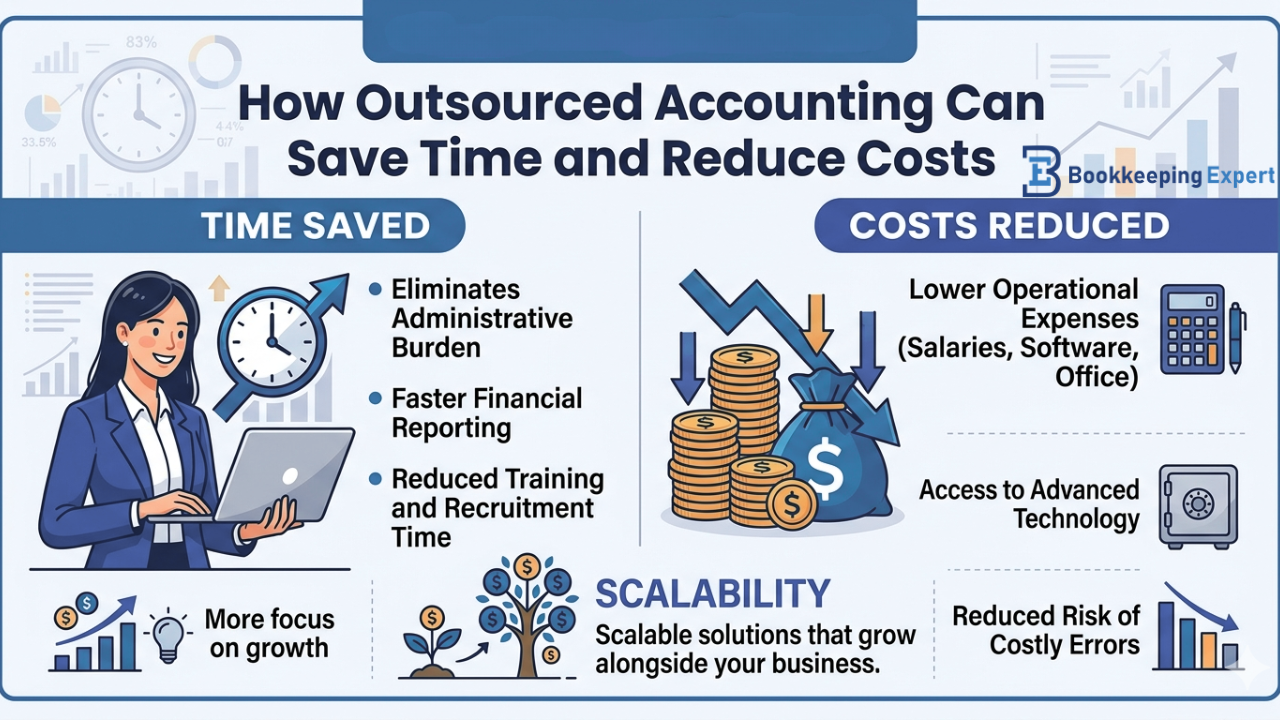
How Outsourced Accounting Saves Valuable Time
Time is one of the most valuable resources for any business owner. Managing accounting tasks internally can consume hours that could otherwise be spent on growth-focused activities.
Outsourced accounting helps businesses reclaim that time.
1. Eliminates Administrative Burden
Accounting tasks involve detailed recordkeeping, reconciliations, and compliance monitoring. These activities require continuous attention and precision.
By outsourcing accounting functions, businesses can eliminate the administrative burden of managing daily financial operations. Experienced professionals handle these responsibilities efficiently, ensuring that records remain accurate and up to date.
This allows business owners and managers to focus on strategic planning, customer relationships, and revenue generation.
2. Faster Financial Reporting
Timely financial information is essential for effective decision-making. However, in-house teams often struggle with reporting delays due to workload and limited resources.
Outsourced accounting teams specialize in streamlined financial processes and reporting systems. They can generate accurate financial reports quickly, helping businesses gain real-time insights into:
-
Revenue performance
-
Operational expenses
-
Profitability trends
-
Cash flow health
Access to timely data allows leaders to make informed business decisions faster.
3. Reduced Training and Recruitment Time
Hiring skilled accounting professionals requires significant time and resources. Businesses must go through recruitment processes, training programs, and ongoing employee management.
Outsourcing eliminates the need for these activities. Companies gain immediate access to trained accounting professionals without spending time on hiring or onboarding.
This makes outsourced accounting a more efficient and flexible staffing solution.
How Outsourced Accounting Reduces Business Costs
In addition to saving time, outsourced accounting also delivers significant financial benefits.
1. Lower Operational Expenses
Maintaining an in-house accounting team involves several expenses, including:
-
Salaries and employee benefits
-
Accounting software licenses
-
Office space and equipment
-
Training and professional development
Outsourcing allows businesses to pay only for the services they require, eliminating many of these overhead costs.
This flexible model helps companies control expenses while maintaining high-quality financial management.
2. Access to Advanced Technology Without Additional Investment
Accounting technology continues to evolve rapidly. Modern tools offer automation, real-time reporting, and improved financial analysis.
However, purchasing and maintaining these systems can be expensive for small and medium-sized businesses.
Outsourced accounting providers typically use advanced accounting platforms and cloud-based systems, allowing businesses to benefit from modern technology without additional investment.
This improves efficiency while reducing infrastructure costs.
3. Reduced Risk of Costly Errors
Financial mistakes can be expensive. Errors in bookkeeping or tax filings may lead to penalties, compliance issues, or incorrect financial reporting.
Professional accounting teams follow standardized procedures and quality control processes to ensure accuracy. Their expertise significantly reduces the risk of financial mistakes.
By preventing costly errors, outsourced accounting helps businesses protect their financial stability.
Scalability for Growing Businesses
As businesses grow, their accounting needs become more complex. Expanding an internal finance department requires additional hiring, training, and management.
Outsourced accounting services offer scalable solutions that grow alongside the business. Companies can increase or adjust services based on changing financial requirements.
This flexibility makes outsourcing particularly valuable for startups, small businesses, and rapidly growing companies.
A Strategic Advantage for Modern Businesses
Outsourcing accounting is no longer simply about reducing costs—it is about improving efficiency, gaining expert financial support, and enabling smarter business decisions.
Companies that outsource their accounting functions often experience:
-
Improved financial accuracy
-
Better cost control
-
Increased operational efficiency
-
More time to focus on growth
By leveraging external expertise, businesses can transform accounting from an administrative task into a strategic advantage.
Final Thoughts
Outsourced accounting has become an essential solution for businesses looking to save time, reduce operational costs, and strengthen financial management.
Instead of managing complex accounting processes internally, companies can rely on experienced professionals who deliver accurate financial reporting, compliance support, and scalable services.
For businesses aiming to operate more efficiently and focus on growth, outsourced accounting provides the expertise and flexibility needed to thrive in today’s dynamic business environment.
