
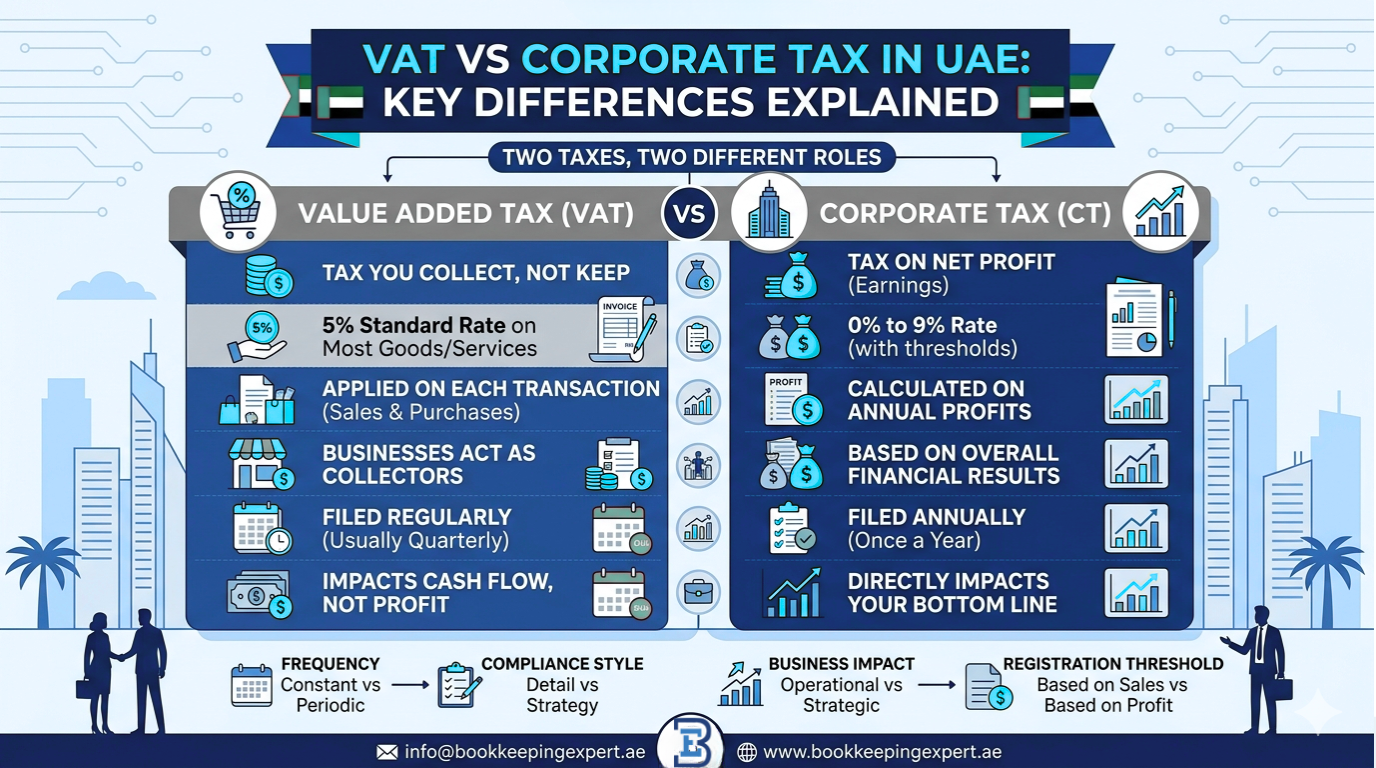
The UAE’s tax landscape has evolved rapidly, shifting from a largely tax-free environment to a more structured system that includes both Value Added Tax (VAT) and Corporate Tax. For modern businesses, the challenge isn’t just compliance—it’s understanding how these two taxes behave differently and how they influence daily operations versus long-term strategy.
Let’s break it down in a way that actually makes sense for business owners.
Two Taxes, Two Completely Different Roles
At a glance, VAT and Corporate Tax may seem like part of the same system—but they serve entirely different purposes.
-
VAT lives in your day-to-day transactions.
-
Corporate Tax lives in your financial results.
Think of VAT as something you handle frequently, while Corporate Tax is something you analyze periodically.
VAT: A Tax You Collect, Not Keep
VAT in the UAE is applied at a standard rate of 5% on most goods and services. But here’s the key point: it’s not your money.
Businesses act as collectors. You charge VAT on sales, pay VAT on purchases, and settle the difference with the government.
What makes VAT unique:
-
It’s tied to every sale and purchase
-
Requires consistent invoicing accuracy
-
Filed regularly (usually quarterly)
-
Impacts cash flow timing, not profit
In short, VAT is operational. It demands discipline in how you record and report transactions.
Corporate Tax: A Tax on What You Actually Earn
Corporate Tax, on the other hand, is calculated on your net profit—what’s left after expenses.
This means it’s not about individual transactions but about your overall financial performance.
What defines Corporate Tax:
-
Based on annual profits
-
Filed once per financial year
-
Requires proper financial statements
-
Directly impacts your bottom line
Unlike VAT, Corporate Tax is deeply connected to how well your business performs and how efficiently it’s structured.
Frequency: Constant vs Periodic
One of the biggest practical differences is how often you deal with each:
-
VAT is ongoing—every invoice, every expense, every filing cycle
-
Corporate Tax is periodic—reviewed and filed annually
VAT is like a continuous stream, while Corporate Tax is more like a yearly checkpoint.
Compliance Style: Detail vs Strategy
VAT compliance is all about precision:
-
Correct tax rates
-
Proper documentation
-
Timely filings
Corporate Tax compliance is about strategy:
-
Expense optimization
-
Revenue recognition
-
Tax planning opportunities
If VAT is about getting the numbers right, Corporate Tax is about understanding what those numbers mean.
Business Impact: Immediate vs Long-Term
VAT affects your daily operations—pricing, invoicing, and cash handling.
Corporate Tax affects your big decisions—investment planning, business expansion, and profit management.
Ignoring VAT leads to operational issues. Ignoring Corporate Tax leads to financial inefficiency.
Registration and Thresholds
VAT registration becomes mandatory once your business crosses a specific revenue threshold, with an option for voluntary registration below that.
Corporate Tax applies broadly across businesses in the UAE, but liability depends on profit thresholds.
So while VAT depends on how much you sell, Corporate Tax depends on how much you earn.
Where Businesses Often Go Wrong
Let’s be honest—most compliance issues don’t come from complexity, but from misunderstanding:
-
Treating VAT as revenue instead of a liability
-
Failing to reconcile VAT regularly
-
Not preparing for Corporate Tax throughout the year
-
Overlooking proper expense documentation
These mistakes aren’t rare—they’re predictable when systems aren’t in place.
A Smarter Way to Manage Both
The most successful businesses don’t treat VAT and Corporate Tax as separate headaches. They build systems that handle both seamlessly:
-
Clean, real-time bookkeeping
-
Automated tracking for VAT
-
Periodic financial reviews for Corporate Tax
-
Proactive planning instead of reactive filing
This integrated approach reduces risk and improves financial clarity.
Final Perspective
VAT and Corporate Tax aren’t just compliance requirements—they’re two lenses through which your business is evaluated.
One reflects how you operate, the other reflects how you perform.
Understanding both—and managing them correctly—gives you more than compliance. It gives you control, clarity, and confidence in your financial decisions.
