
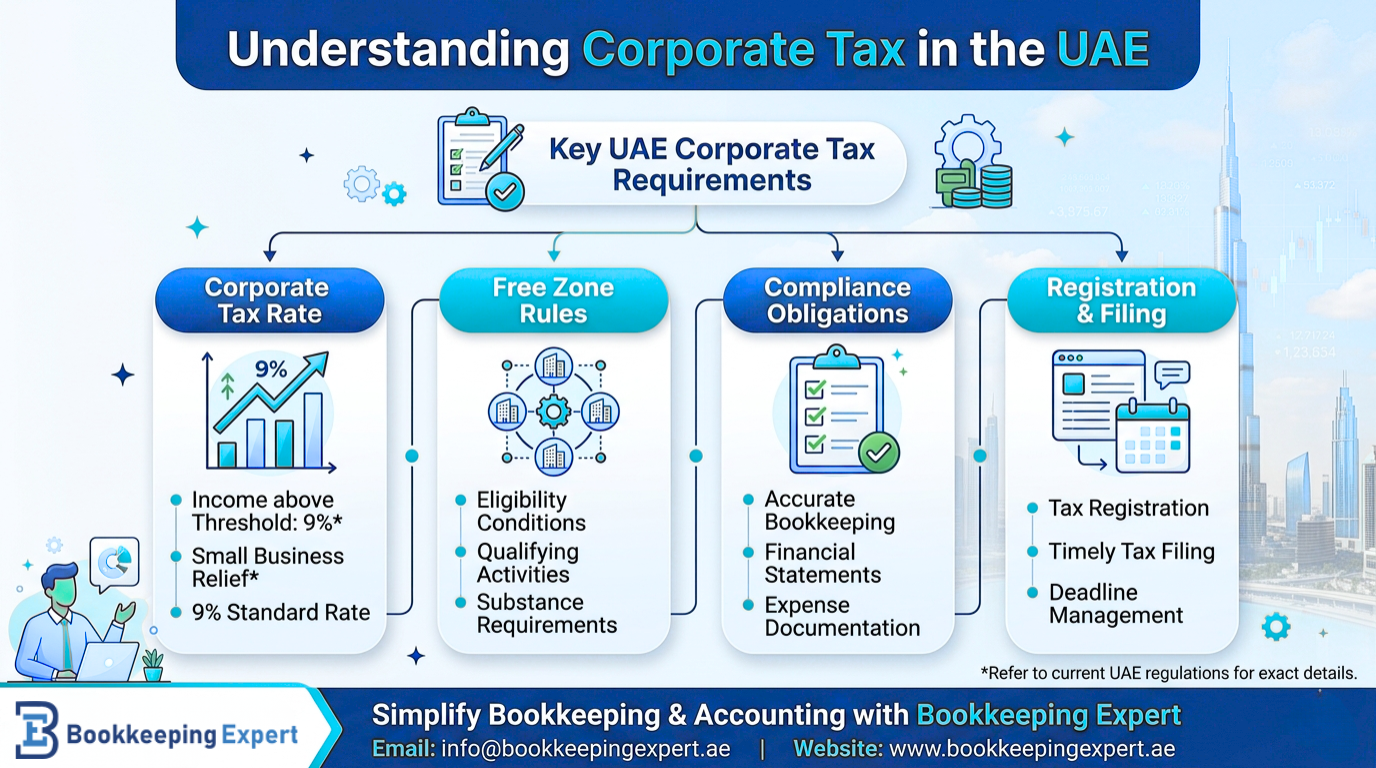
The United Arab Emirates has long been recognized as one of the world’s most business-friendly destinations, attracting startups, multinational companies, investors, and entrepreneurs from across the globe. However, with the introduction of corporate tax regulations, businesses operating in the UAE are now entering a new era of financial compliance and strategic tax planning.
While the UAE continues to offer a highly competitive business environment, understanding corporate tax obligations has become essential for companies aiming to maintain compliance, avoid penalties, and build sustainable growth.
At Bookkeeping Expert, we help businesses navigate modern accounting, bookkeeping, and tax compliance requirements across the UAE. Here’s a complete guide to understanding corporate tax in the UAE and what it means for businesses today.
What Is Corporate Tax in the UAE?
Corporate tax is a direct tax imposed on the net profits of businesses operating within the UAE.
The UAE introduced federal corporate tax to align with global tax standards while maintaining its reputation as an attractive business hub for international investment and entrepreneurship.
The corporate tax framework is designed to:
-
Strengthen financial transparency
-
Support economic diversification
-
Meet international tax compliance standards
-
Enhance long-term economic sustainability
Despite the introduction of corporate tax, the UAE remains one of the most competitive tax environments globally.
Corporate Tax Rate in the UAE
Under the UAE corporate tax regime:
-
Taxable income up to a specified threshold may qualify for a lower or zero-tax bracket
-
Income exceeding the threshold is generally subject to a standard corporate tax rate
The structure is intended to support:
-
Small businesses
-
Startups
-
Entrepreneurs
-
Growing enterprises
Different tax treatments may apply depending on:
-
Business structure
-
Industry type
-
Free zone eligibility
-
International operations
Businesses should carefully assess their financial position to understand their tax exposure accurately.
Which Businesses Are Subject to Corporate Tax?
Corporate tax generally applies to:
-
Mainland companies
-
Foreign entities operating in the UAE
-
Commercial activities conducted under business licenses
-
Certain free zone entities depending on qualification status
However, tax obligations can vary significantly based on operational structure and compliance conditions.
Businesses operating in:
-
Trading
-
Professional services
-
Technology
-
E-commerce
-
Manufacturing
-
Consultancy
-
Real estate
-
Financial services
must carefully evaluate their registration and filing responsibilities.
Understanding Free Zone Tax Rules
Free zones continue to play a major role in the UAE economy.
Many free zone businesses may still benefit from preferential tax treatment if they meet qualifying conditions.
However, eligibility depends on factors such as:
-
Nature of business activities
-
Compliance with regulatory requirements
-
Proper financial reporting
-
Substance requirements
-
Transactions with mainland businesses
Businesses operating in free zones should avoid assuming automatic exemptions without professional review.
Why Corporate Tax Compliance Matters
Strong corporate tax compliance helps businesses:
-
Avoid penalties
-
Maintain business licenses
-
Improve investor confidence
-
Support banking relationships
-
Strengthen financial transparency
-
Reduce audit risks
As UAE regulations continue modernizing, businesses are expected to maintain accurate financial records and timely reporting systems.
Key Corporate Tax Compliance Requirements
Corporate Tax Registration
Eligible businesses must register with the relevant tax authorities within the required timeframe.
Failure to register properly may result in penalties or operational issues.
Accurate Financial Reporting
Businesses should maintain:
-
Proper bookkeeping records
-
Financial statements
-
Expense documentation
-
Revenue tracking
-
Supporting invoices
Accurate accounting forms the foundation of corporate tax compliance.
Timely Tax Filing
Companies must file tax returns within prescribed deadlines.
Late filing may trigger:
-
Financial penalties
-
Compliance notices
-
Additional scrutiny
Establishing internal tax calendars helps businesses stay organized.
Documentation and Audit Readiness
Businesses should maintain organized records for:
-
Income
-
Expenses
-
Contracts
-
Payroll
-
Bank transactions
-
Related-party transactions
Strong documentation improves audit preparedness and reduces compliance risks.
The Growing Importance of Bookkeeping in the UAE
With corporate tax now part of the UAE business landscape, bookkeeping has become more important than ever.
Professional bookkeeping helps businesses:
-
Track taxable income accurately
-
Prepare financial statements
-
Maintain compliance records
-
Improve cash flow visibility
-
Support strategic decision-making
Cloud accounting systems and outsourced bookkeeping services are becoming increasingly popular among UAE businesses seeking efficiency and scalability.
At Bookkeeping Expert, we provide modern bookkeeping and accounting solutions tailored to UAE tax compliance requirements.
Common Challenges Businesses Face
Understanding New Regulations
Many businesses are still adapting to evolving tax requirements and compliance expectations.
Managing Financial Records
Poor bookkeeping can lead to inaccurate filings and compliance risks.
Free Zone Complexity
Determining eligibility for free zone tax benefits can be challenging without professional guidance.
Resource Limitations
Small and growing businesses may lack in-house tax expertise.
Technology Integration
Manual accounting systems often struggle to support modern tax reporting requirements.
Best Practices for Managing UAE Corporate Tax
Businesses can improve compliance by:
-
Implementing cloud accounting software
-
Maintaining accurate bookkeeping records
-
Conducting regular financial reviews
-
Monitoring tax regulation updates
-
Working with experienced accounting professionals
-
Automating repetitive financial processes
Proactive tax management helps reduce stress and improve operational efficiency.
The Future of Corporate Tax in the UAE
The UAE is rapidly evolving into a highly transparent and globally aligned financial ecosystem.
Future trends may include:
-
Increased digital tax reporting
-
AI-driven compliance monitoring
-
Greater financial transparency requirements
-
Enhanced audit systems
-
Expanded automation in accounting and tax filing
Businesses that build strong financial systems early will be better positioned for long-term success.
Final Thoughts
Corporate tax represents a significant shift in the UAE business environment, but it also creates opportunities for stronger financial discipline, transparency, and strategic growth.
Businesses that invest in proper bookkeeping, modern accounting systems, and proactive compliance management can navigate the new tax landscape with confidence.
Understanding corporate tax is no longer optional — it is now a critical part of running a successful business in the UAE.
At Bookkeeping Expert, we help businesses simplify bookkeeping, accounting, and corporate tax compliance through reliable and scalable financial solutions tailored for the UAE market.
