
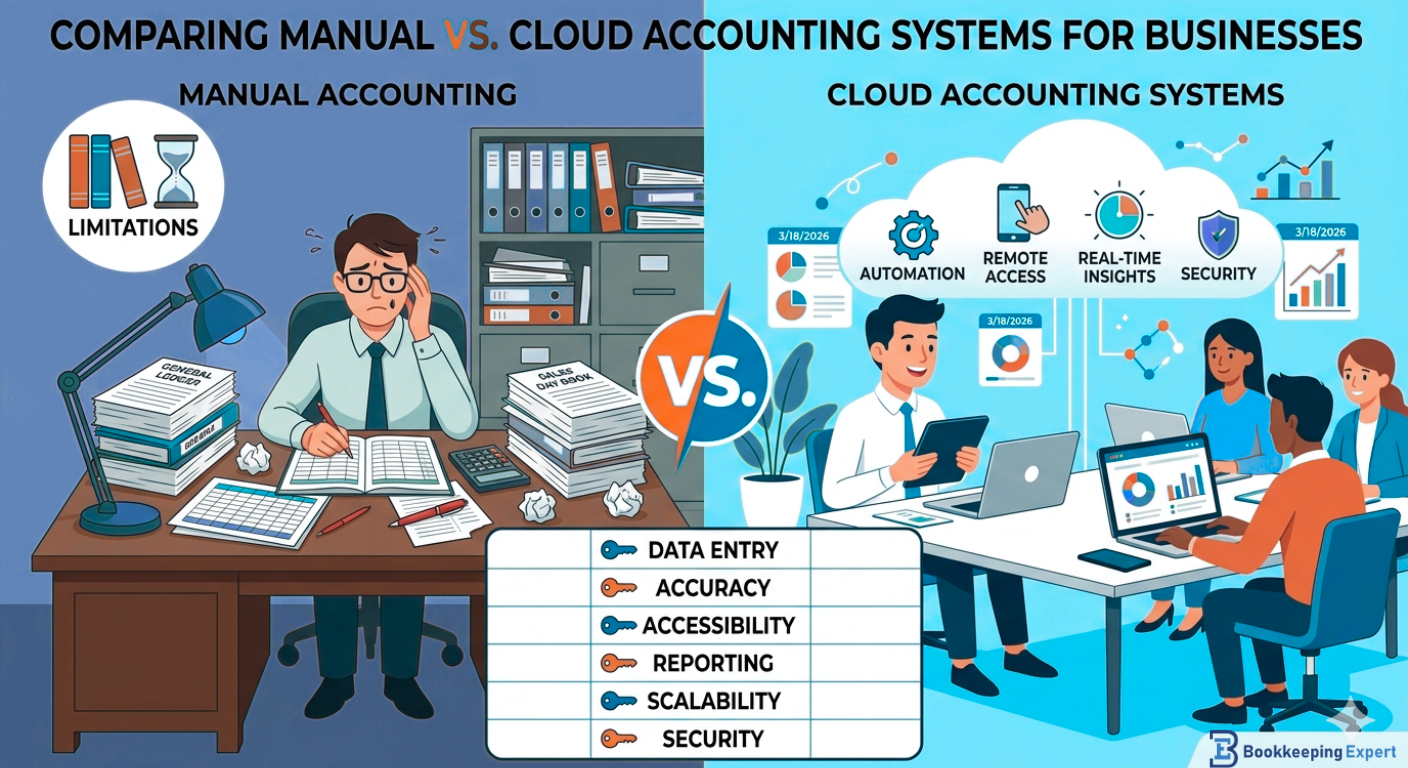
In today’s digital-first economy, the way businesses manage their finances can significantly impact growth, efficiency, and decision-making. Accounting systems have evolved from traditional ledgers and spreadsheets to intelligent, cloud-based platforms that offer real-time insights and automation. But for many businesses, especially growing SMEs, the question remains: Should you stick with manual accounting or move to the cloud?
Let’s break down the differences and help you determine which approach best fits your business needs.
The Traditional Approach: Manual Accounting
Manual accounting relies on physical records, spreadsheets, and human input for every financial transaction. While it may seem cost-effective initially, it often comes with limitations that can slow down business operations.
Pros of Manual Accounting
Low initial cost: No need for software subscriptions
Full control: Direct oversight of every transaction
Simple setup: Suitable for very small businesses with minimal transactions
Challenges of Manual Accounting
Time-consuming processes: Recording and reconciling data manually takes hours
Higher risk of errors: Human mistakes can lead to financial discrepancies
Limited scalability: Difficult to manage as the business grows
Lack of real-time data: Financial insights are delayed and often outdated
Data security risks: Physical records can be lost or damaged
Manual accounting may work for micro-businesses, but it often becomes a bottleneck as complexity increases.
The Modern Solution: Cloud Accounting Systems
Cloud accounting uses online platforms to manage financial data securely and efficiently. It allows businesses to access their accounts anytime, anywhere, with automation handling repetitive tasks.
Pros of Cloud Accounting
Real-time financial insights: Access up-to-date reports instantly
Automation of tasks: Invoicing, payroll, and reconciliations are streamlined
Enhanced accuracy: Reduced human error through system calculations
Scalability: Easily adapts as your business grows
Data security: Encrypted storage with regular backups
Remote accessibility: Manage finances from anywhere in the world
Challenges of Cloud Accounting
Subscription costs: Ongoing monthly or annual fees
Internet dependency: Requires stable connectivity
Learning curve: Initial training may be needed for teams
Despite these considerations, cloud accounting has become the preferred choice for modern businesses aiming for efficiency and agility.
Key Differences at a Glance
| Feature |
Manual Accounting |
Cloud Accounting |
| Data Entry | Fully manual | Automated & integrated |
| Accuracy | Prone to errors | High accuracy |
| Accessibility | Limited | Anytime, anywhere |
| Reporting | Delayed | Real-time |
| Scalability | Limited | Highly scalable |
| Security | Physical risks | Advanced encryption |
Which One is Right for Your Business?
The answer depends on your business size, goals, and operational complexity.
Choose manual accounting if:
You run a very small business with minimal transactions and limited budget.
Choose cloud accounting if:
You want efficiency, scalability, and real-time financial visibility to support growth.
For most businesses today, the shift to cloud accounting is not just an upgrade—it’s a strategic move toward smarter financial management.
Why Businesses Are Moving to the Cloud
Businesses in the UAE and beyond are rapidly adopting cloud accounting to stay competitive. With increasing regulatory requirements and the need for accurate financial reporting, relying on outdated systems can hold you back.
At Bookkeeping Expert, we help businesses transition seamlessly from manual processes to advanced cloud accounting solutions. Our expertise ensures that your financial systems are not only efficient but also aligned with your long-term business goals.
Final Thoughts
The comparison between manual and cloud accounting ultimately comes down to efficiency vs. limitation. While manual systems may offer simplicity, they lack the speed and intelligence required in today’s business environment. Cloud accounting, on the other hand, empowers businesses with automation, insights, and flexibility.
If your goal is to grow, scale, and make informed decisions, the cloud is no longer optional—it’s essential
