
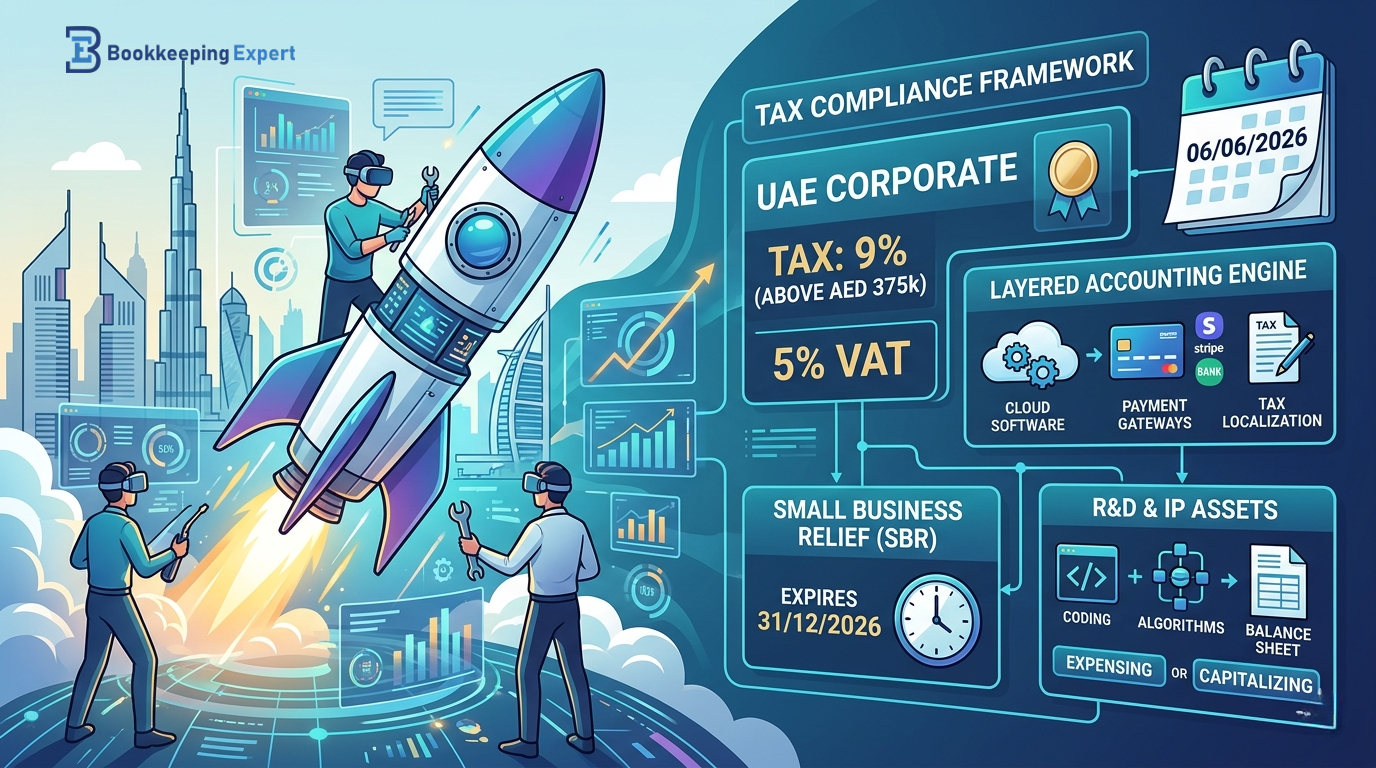
For a fast-growing tech startup, handling finances feels like building a rocket ship mid-flight. You are laser-focused on coding, raising capital, and acquiring users. However, ignoring tax regulations early on can lead to serious legal hurdles or unexpected financial gaps later.
With the UAE’s rapidly changing tax landscape—including the recently implemented 9% Corporate Tax and structural Value-Added Tax (VAT) rules—compliance is no longer an afterthought (Qabajeh, 2024). It is a core pillar of your business health.
At Bookkeeping Expert, we regularly step in to help tech startups build non-repetitive, airtight compliance systems. Here is exactly how your startup should approach tax compliance from day one.
1. Choose the Right Legal & Tax Structure
Your tax obligations begin with where your company is registered. Startups in the UAE generally face two options:
-
Mainland Entities: Subject to local regulations, standard UAE Corporate Tax, and custom procedures.
-
Free Zones: Many Free Zones offer highly competitive corporate tax exemptions (often 0% on qualifying income), making them incredibly attractive to tech startups.
The Catch: Free Zone entities must maintain strict "substance" rules (like having actual local operations and minds managing the company) and comply with complex regulatory filing requirements to keep that 0% rate. Choosing the wrong setup early on can create a chaotic administrative chain later.
2. Implement the "Three-Layer" Accounting Engine
To remain agile and compliant, your startup needs to transition away from messy manual spreadsheets. Instead, establish a clear three-layer financial accounting framework:
|
Layer |
Component |
Function for Your Startup |
|
Layer 1 |
Cloud Accounting Software |
Automated record-keeping (e.g., Xero, QuickBooks) tailored for tech workflows. |
|
Layer 2 |
Integrated Payment Gateways |
Syncing Stripe, checkout.com, or local banks to match invoices automatically. |
|
Layer 3 |
Localization & Tax Mapping |
Configuring your ledger to auto-tag UAE Corporate Tax rules and localized VAT. |
By connecting your live bank accounts and localized payment systems directly to your cloud software, your tax computations generate effortlessly in real time, eliminating the rush at the end of the year.
3. Demystify the UAE Corporate Tax Thresholds
A common trap for young startups is assuming that if they aren't highly profitable yet, they don't have to file. This is a critical misconception.
In the UAE, all businesses must register for Corporate Tax and file an annual return, regardless of their size or whether they are making a profit. However, the system is designed to be highly supportive of small and early-stage companies:
|
Taxable Income Tier |
Applicable Tax Rate |
What it means for your Tech Startup |
|
Up to AED 375,000 |
0% |
Protects early-stage cash flows while your company scales. |
|
Above AED 375,000 |
9% |
Standard rate applied strictly to the portion of profits exceeding the baseline. |
The Small Business Relief (SBR) Safety Net
The UAE's Small Business Relief (SBR) program allows eligible resident businesses with gross revenues below AED 3,000,000 to elect to be treated as having no taxable income for a given tax period.
Important Notice for 2026: Under Ministerial Decision No. 73/2023, this current tax period ending on or before December 31, 2026, represents the final eligible year to claim SBR. It is not automatic—you must actively elect it on your return. Furthermore, if you choose SBR, you cannot carry forward tax losses or net interest expenses to future years, which is a major trade-off for early-stage startups sitting on heavy initial R&D expenses.
4. Automate Invoicing for VAT Compliance
If your software-as-a-service (SaaS) or e-commerce platform hits an annual taxable turnover of AED 375,000, mandatory registration for the 5% UAE VAT is required (Qabajeh, 2024).
Because digital startups scale quickly across international borders, your invoicing platform must automatically distinguish between:
-
Local B2B/B2C Sales: Charging the standard 5% UAE VAT rate.
-
Cross-Border Digital Goods: Applying the proper zero-rated or out-of-scope rules based on where your customer is located.
Failing to properly configure these settings can severely harm your net operating cash flows and impact short-term liquidity (Qabajeh, 2024).
5. Track Software R&D and Intellectual Property Assets
For tech startups, software code, proprietary algorithms, and intellectual property (IP) represent significant value. How you account for these assets drastically impacts your tax liabilities:
-
Expensing R&D: Offsetting your everyday operational costs directly against your current taxable revenue to lower immediate tax burdens.
-
Capitalizing Assets: Documenting software creation as an intangible asset on your balance sheet, allowing you to spread out its value over time through amortization (gradually writing off the value of an intangible asset).
Managing this balance carefully ensures your financial books accurately reflect your true valuation to potential investors while maintaining total compliance.
Leverage Professional Support Early
Trying to decode shifting tax codes entirely on your own distracts you from what matters most: refining your product and scaling your operations. Partnering with a dedicated financial specialist gives you the clarity you need to grow safely.
At Bookkeeping Expert, we build customized, scalable accounting and tax strategies specifically tailored for innovative tech startups. Let us handle the compliance engine so you can focus entirely on your growth trajectory.
