
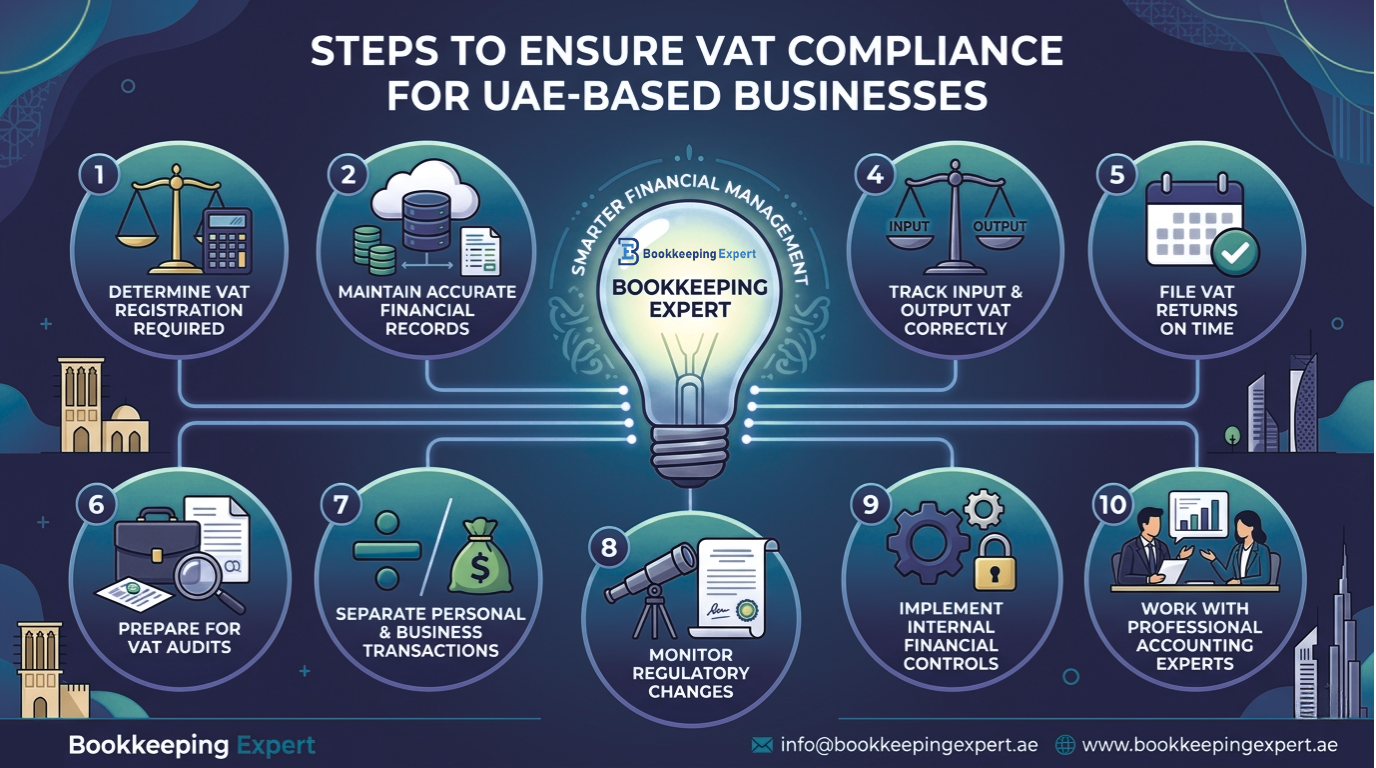
Since the introduction of Value Added Tax (VAT) in the UAE, businesses have had to adapt to a more structured and transparent tax environment. While VAT compliance has become a standard part of operating a business in the UAE, many companies still struggle with maintaining accurate records, filing returns correctly, and understanding evolving regulatory requirements.
VAT compliance is not simply about submitting tax returns on time. It involves maintaining proper financial systems, accurate documentation, and consistent reporting practices throughout the year.
At Bookkeeping Expert, we work with UAE businesses that want to simplify VAT management while reducing compliance risks and improving financial visibility.
Why VAT Compliance Matters in the UAE
Non-compliance with UAE VAT regulations can lead to:
-
financial penalties,
-
operational disruptions,
-
audit complications,
-
reputational risks,
-
and unnecessary financial stress.
On the other hand, businesses with strong VAT compliance processes often benefit from:
-
smoother financial operations,
-
better reporting accuracy,
-
stronger internal controls,
-
and improved business credibility.
VAT compliance also supports long-term business scalability, especially for companies dealing with multiple suppliers, international transactions, and rapid growth.
Step 1: Determine Whether VAT Registration is Required
The first step toward compliance is understanding whether your business meets the UAE VAT registration threshold.
Businesses must monitor their taxable turnover carefully to determine:
-
mandatory registration eligibility,
-
voluntary registration opportunities,
-
and ongoing compliance obligations.
Delaying VAT registration can result in penalties and retrospective tax liabilities.
Businesses should regularly review revenue trends to ensure registration requirements are identified early.
Step 2: Maintain Accurate Financial Records
Strong bookkeeping is the foundation of VAT compliance.
Every transaction related to:
-
sales,
-
purchases,
-
expenses,
-
supplier invoices,
-
and customer payments
must be properly recorded and organized.
Incomplete or inaccurate bookkeeping often leads to:
-
incorrect VAT calculations,
-
filing errors,
-
and compliance risks during audits.
Cloud accounting systems such as QuickBooks, Xero, and Zoho Books help businesses automate VAT tracking and improve reporting accuracy.
Step 3: Issue VAT-Compliant Invoices
VAT invoices must contain all required information under UAE tax regulations.
This typically includes:
-
VAT registration number,
-
invoice date,
-
invoice number,
-
taxable amount,
-
VAT amount,
-
and supplier details.
Incorrect invoicing can create problems for both businesses and customers, especially when claiming input VAT credits.
Businesses should standardize invoicing procedures to reduce errors and maintain consistency.
Step 4: Track Input and Output VAT Correctly
A major part of VAT compliance involves distinguishing between:
-
output VAT collected from customers,
-
and input VAT paid on business purchases.
Errors in VAT classification may lead to:
-
underpayment,
-
overpayment,
-
or rejected VAT claims.
Businesses should regularly reconcile VAT accounts to ensure all transactions are categorized correctly.
This becomes especially important for businesses handling:
-
international trade,
-
mixed taxable supplies,
-
or multiple revenue streams.
Step 5: File VAT Returns on Time
Timely VAT return filing is critical for avoiding penalties.
Many businesses face compliance issues not because of incorrect reporting, but because deadlines are missed.
An organized VAT calendar helps businesses:
-
track filing dates,
-
prepare documentation in advance,
-
and maintain smoother reporting cycles.
Monthly financial reviews can also reduce last-minute filing pressure.
Step 6: Prepare for VAT Audits
As UAE tax regulations continue to evolve, businesses should be prepared for potential tax audits or reviews.
Audit readiness requires:
-
organized documentation,
-
clear transaction records,
-
supporting invoices,
-
and accurate reconciliations.
Businesses should maintain proper record retention policies and ensure financial data remains accessible and secure.
Strong internal controls significantly reduce audit-related stress.
Step 7: Separate Personal and Business Transactions
One common issue among small and growing businesses is the mixing of personal and business expenses.
This creates confusion in:
-
VAT reporting,
-
expense classification,
-
and financial reconciliations.
Using separate business accounts and structured accounting processes helps maintain cleaner financial records and improves compliance accuracy.
Step 8: Monitor Regulatory Changes
VAT regulations and compliance requirements may evolve over time.
Businesses that fail to stay updated on:
-
filing procedures,
-
documentation standards,
-
or regulatory changes
can unintentionally create compliance risks.
Working with experienced accounting professionals helps businesses remain informed and prepared for regulatory updates.
Step 9: Implement Internal Financial Controls
Strong internal controls improve both VAT compliance and overall financial management.
Businesses should establish processes for:
-
invoice approvals,
-
transaction reviews,
-
expense verification,
-
and financial reconciliations.
Internal controls reduce the risk of:
-
reporting errors,
-
duplicate transactions,
-
fraud,
-
and missing documentation.
Financial discipline plays a major role in maintaining long-term compliance.
Step 10: Work with Professional Accounting Experts
VAT compliance can become increasingly complex as businesses grow.
Companies managing:
-
multiple transactions,
-
international suppliers,
-
large operational expenses,
-
or rapid expansion
often benefit from professional bookkeeping and accounting support.
Outsourced accounting professionals help businesses:
-
maintain accurate records,
-
manage VAT filings,
-
improve reporting systems,
-
and reduce compliance risks.
This allows business owners to focus more on operations and growth while ensuring financial obligations are handled correctly.
Technology Is Transforming VAT Compliance
Modern accounting technology has made VAT management significantly more efficient.
Automation tools now help businesses:
-
calculate VAT automatically,
-
generate reports instantly,
-
monitor compliance in real time,
-
and reduce manual errors.
Digital accounting systems also improve transparency and support better financial decision-making.
Businesses that adopt modern accounting technology are often better equipped to handle evolving compliance requirements efficiently.
Final Thoughts
VAT compliance is no longer just an administrative requirement for UAE businesses. It is an essential part of responsible financial management and operational stability.
Businesses that maintain organized accounting systems, accurate reporting, and proactive compliance practices are often better positioned for:
-
sustainable growth,
-
financial transparency,
-
stronger credibility,
-
and reduced operational risk.
In today’s competitive business environment, effective VAT management supports both compliance and long-term business success.
At Bookkeeping Expert, we help UAE businesses simplify bookkeeping, strengthen VAT compliance, and build smarter financial management systems designed for modern business operations.
