
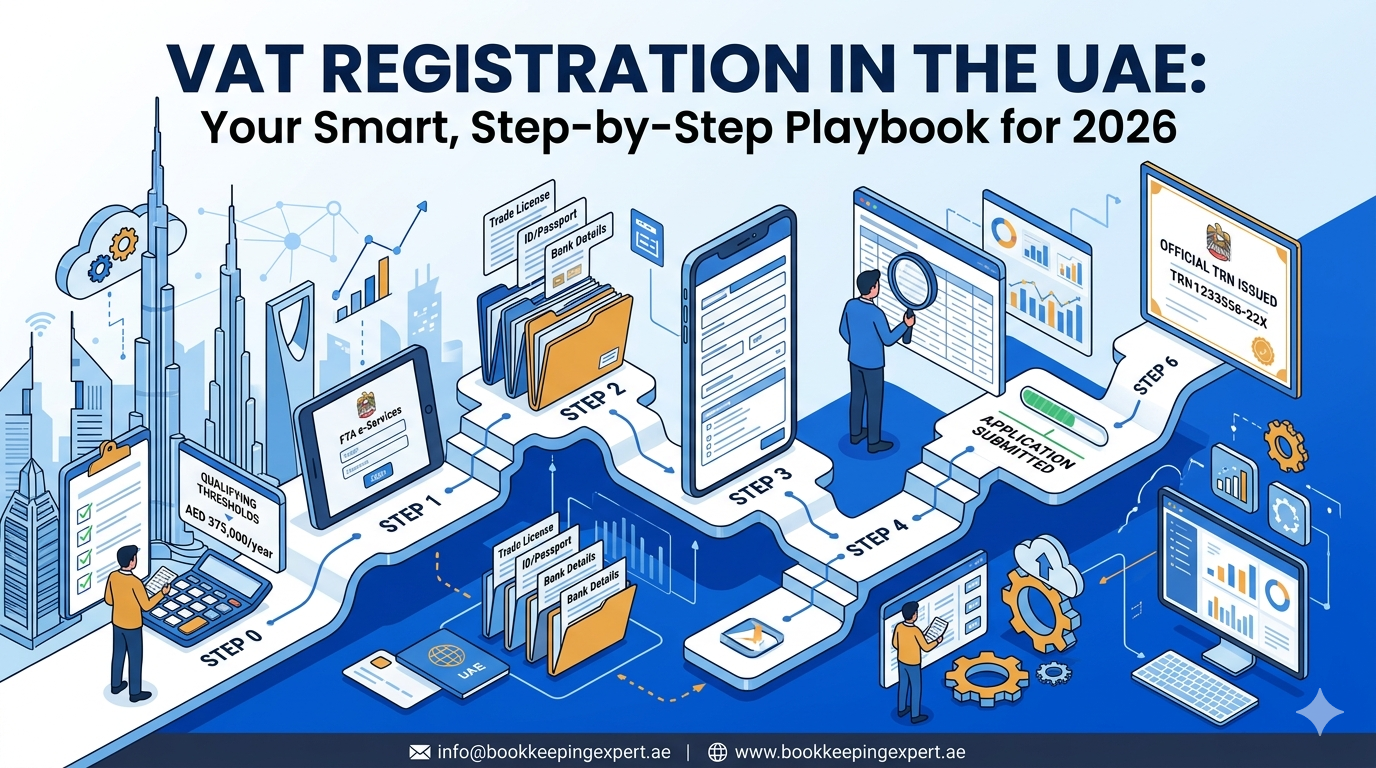
Setting up a business in the United Arab Emirates is exciting—but staying compliant is what keeps it running smoothly. One of the most important steps is registering for VAT. While it might sound technical, the process is actually straightforward when broken down correctly.
This guide gives you a clean, modern roadmap to get VAT-registered without confusion.
Understanding VAT in the UAE
Value Added Tax (VAT) in the UAE is charged at 5% on most goods and services. It is regulated by the Federal Tax Authority (FTA), which manages registration, filing, and compliance.
If your business crosses certain revenue thresholds, registration isn’t optional—it’s mandatory.
Step 0: Check If You Qualify
Before starting, determine your eligibility:
-
Mandatory Registration: Revenue exceeds AED 375,000/year
-
Voluntary Registration: Revenue exceeds AED 187,500/year
Tip: Even if not required, voluntary registration can enhance credibility and allow input tax recovery.
Step-by-Step VAT Registration Process
Step 1: Set Up Your FTA e-Services Account
Head to the FTA portal and create your login credentials. This dashboard is where all your tax activities will live.
You’ll need:
-
Active email
-
Business contact details
Step 2: Prepare Your Documentation Folder
Think of this as your “VAT toolkit.” Gather:
-
Trade license
-
Owner/partner identification
-
Business activity details
-
Bank account information
-
Annual turnover proof
Having everything ready avoids interruptions during the application.
Step 3: Start Your VAT Application
Inside your FTA dashboard, begin the VAT registration form. You’ll be asked about:
-
Nature of your business
-
Revenue streams
-
GCC trade activities
-
Expected turnover
Insight: Be precise—this data determines your VAT obligations.
Step 4: Review Like a Pro
Before submitting, double-check:
-
Trade license numbers
-
Financial figures
-
Contact details
Small errors can delay approval significantly.
Step 5: Submit & Track Your Application
Once submitted, the FTA will review your application. You may receive:
-
Approval
-
Request for clarification
Stay responsive to avoid delays.
Step 6: Get Your TRN (Tax Registration Number)
Once approved, you’ll receive your TRN—your official VAT identity.
Now you must:
-
Charge VAT on invoices
-
File returns on time
-
Maintain proper records
Life After VAT Registration
Registration is just the beginning. To stay compliant, businesses must:
-
File VAT returns (monthly or quarterly)
-
Maintain audit-ready records
-
Track input and output VAT
-
Pay liabilities on time
Common Pitfalls to Avoid
Even experienced businesses slip up. Watch out for:
-
Late registration penalties
-
Incorrect revenue reporting
-
Missing VAT deadlines
-
Poor record-keeping
Tech-Driven VAT Compliance
Modern businesses in the UAE are ditching manual processes and adopting:
-
Cloud accounting systems
-
Automated VAT calculations
-
Real-time financial dashboards
This not only ensures compliance but also improves efficiency and accuracy.
Why VAT Registration Is a Business Advantage
VAT registration isn’t just about compliance—it can actually benefit your business:
-
Builds trust with clients and partners
-
Enables tax recovery on expenses
-
Positions your business as professional and scalable
Final Takeaway
VAT registration in the UAE doesn’t have to be overwhelming. With the right preparation and a structured approach, it becomes a smooth and manageable process.
For businesses aiming to grow in the UAE, mastering VAT is not just a requirement—it’s a strategic step toward financial clarity and long-term success.
