
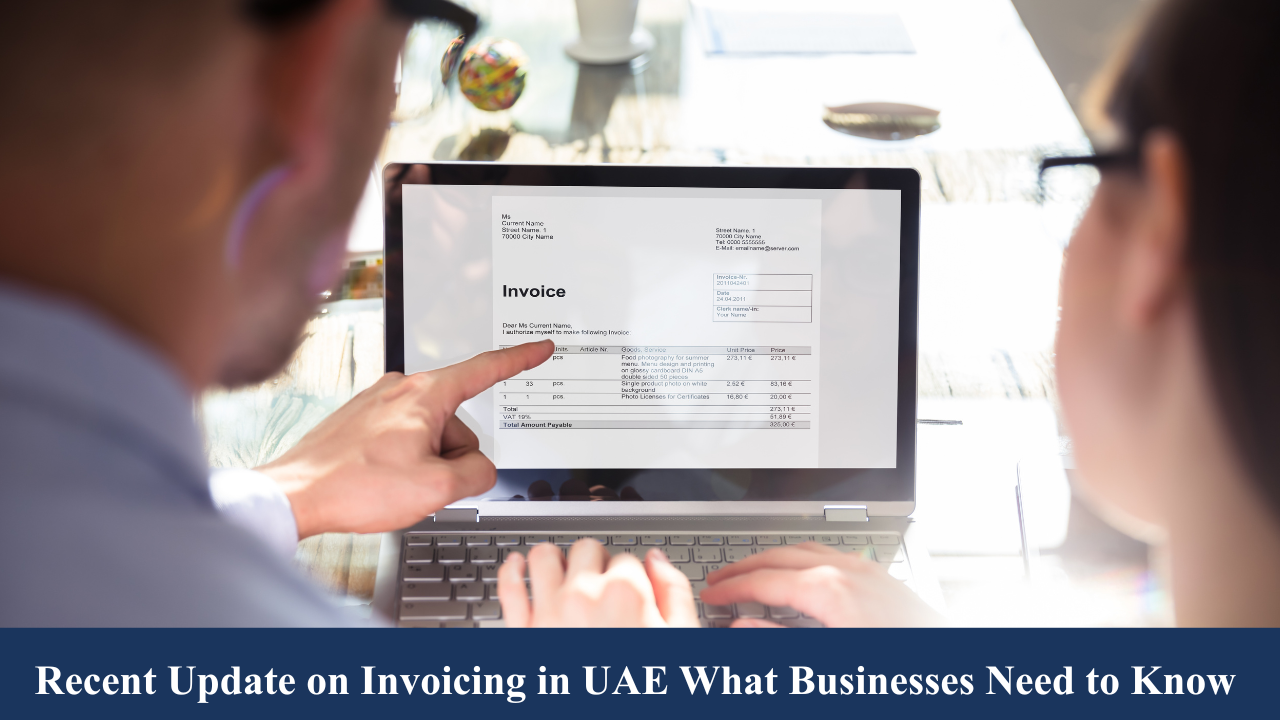
In the UAE, the rules around business invoicing are undergoing significant change. The Federal Tax Authority (FTA) and the Ministry of Finance (MoF) have introduced a new electronic-invoicing (e-Invoicing) system to strengthen tax compliance, digitalize business transactions, and align with global best practices.
If you operate a business in the UAE, you must understand how this change affects your invoicing processes, your accounting system, and your compliance responsibilities. At Bookkeeping Expert, we help companies adapt to these updates, set up compliant systems, and avoid penalties.
What are the Key Invoicing Updates in the UAE
Legal Foundation
Recent regulatory changes have updated the VAT law and invoicing rules. For example, the MoF has published ministerial decisions (such as Ministerial Decision No. 243 of 2025 and Ministerial Decision No. 244 of 2025) which establish requirements for digital invoices and credit notes. Alaan+3Alvarez & Marsal+3Grant Thornton UAE+3
What is e-Invoicing
E-invoicing means issuing, transmitting, receiving and storing invoices in structured digital formats (for example XML or JSON) through an accredited service provider (ASP). The invoice must contain specific data fields and must be stored within the UAE. ClearTax+2TR - Legal Insight Australia+2
Implementation Timeline
The rollout is phased:
-
Pilot starts 1 July 2026 (voluntary) KPMG+1
-
Phase 1 (large businesses, revenue ≥ AED 50 million) mandatory from 1 January 2027 Grant Thornton UAE+1
-
Phase 2 (other VAT-registered businesses) mandatory from 1 July 2027 vatcalc.com+1
Scope and Coverage
The e-Invoicing requirement covers business-to-business (B2B) and business-to-government (B2G) transactions for VAT-registered persons. Some exemptions apply (for example, certain B2C transactions initially) but that may change in future. KPMG+1
What Changes for Invoices
-
Simplified invoice formats currently used may no longer be allowed once e-invoicing is mandatory. Alvarez & Marsal+1
-
Credit notes and invoices for zero-rated supplies will need to comply with full e-invoice data fields. Alvarez & Marsal
-
Businesses must appoint an accredited service provider and ensure their accounting or ERP system is integrated. vatcalc.com+1
Why These Updates Matter for Your Business
-
Compliance Risk: Failure to issue compliant invoices or adopt e-invoicing when required can lead to penalties, rejected invoices, cashflow disruptions. TR - Legal Insight Australia+1
-
VAT Recovery: For VAT-registered businesses, proper invoicing helps to claim input VAT and validates VAT output tax.
-
Data Integrity and Digital Transition: The system enables near-real-time reporting to the FTA and reduces risk of tax leakage.
-
Operational Efficiency: Automating invoice issuance, transmission and storage reduces manual errors and improves payment cycles.
-
Preparedness for Audit / Tax Review: Digital invoices with full data and proper storage enhance audit readiness.
What Your Business Should Do Now
-
Assess your current invoicing process
Review how invoices and credit notes are created, approved, transmitted and stored. Identify manual or paper-based workflows.
-
Check accounting system readiness
Ensure your software (QuickBooks, Xero, Zoho or ERP) can generate structured digital invoices in required format (XML/JSON) and integrate with an ASP.
-
Appoint an Accredited Service Provider (ASP)
Identify and engage an MoF/FTA-accredited ASP who will handle e-invoice conversion, transmission and reporting.
-
Clean up master data
Ensure customer and supplier data is complete (legal name, TRN, address etc) so e-invoice fields can be populated without errors. Alvarez & Marsal
-
Plan for storage and archiving
e-invoices must be stored within the UAE as per tax procedures law. Make sure digital archiving is compliant.
-
Train staff and update processes
Educate your finance and billing teams on new invoice formats, credit note issuance, and how to handle system failures or downtime.
-
Monitor timeline and deadlines
Large businesses: mandatory from Jan 2027. Others: mandatory from July 2027. Voluntary pilots begin July 2026. KPMG+1
Case Study
A mid-sized service company in Dubai recognised the upcoming e-invoicing changes and engaged Bookkeeping Expert six months before the voluntary pilot. We:
-
Reviewed their billing and ERP system
-
Migrated invoice generation into structured XML format
-
Appointed an accredited ASP
-
Cleaned customer data and aligned processes
As a result, when the system goes mandatory they will transition smoothly without major disruption, and gain early operational efficiencies.
Final Thoughts
Invoicing rules in the UAE are evolving. What was once a paper or PDF invoice may soon no longer qualify. Early preparation is key. The transition to e-invoicing is not just compliance — it is an opportunity to improve your finance operations, reduce cost, enhance control and gain competitive advantage.
At Bookkeeping Expert, we support you in navigating these changes — from reviewing your current process, preparing your accounting system, appointing ASPs, to ongoing compliance.
Contact us today for a readiness review and strategic support for invoicing compliance in the UAE.
Disclaimer
This information is based on the UAE Ministry of Finance and Federal Tax Authority guidance available at the time of publication. Invoicing rules, timelines and scope are subject to change by government order. Please verify the latest requirements via official sources or consult a licenced tax advisor before making final decisions.
