
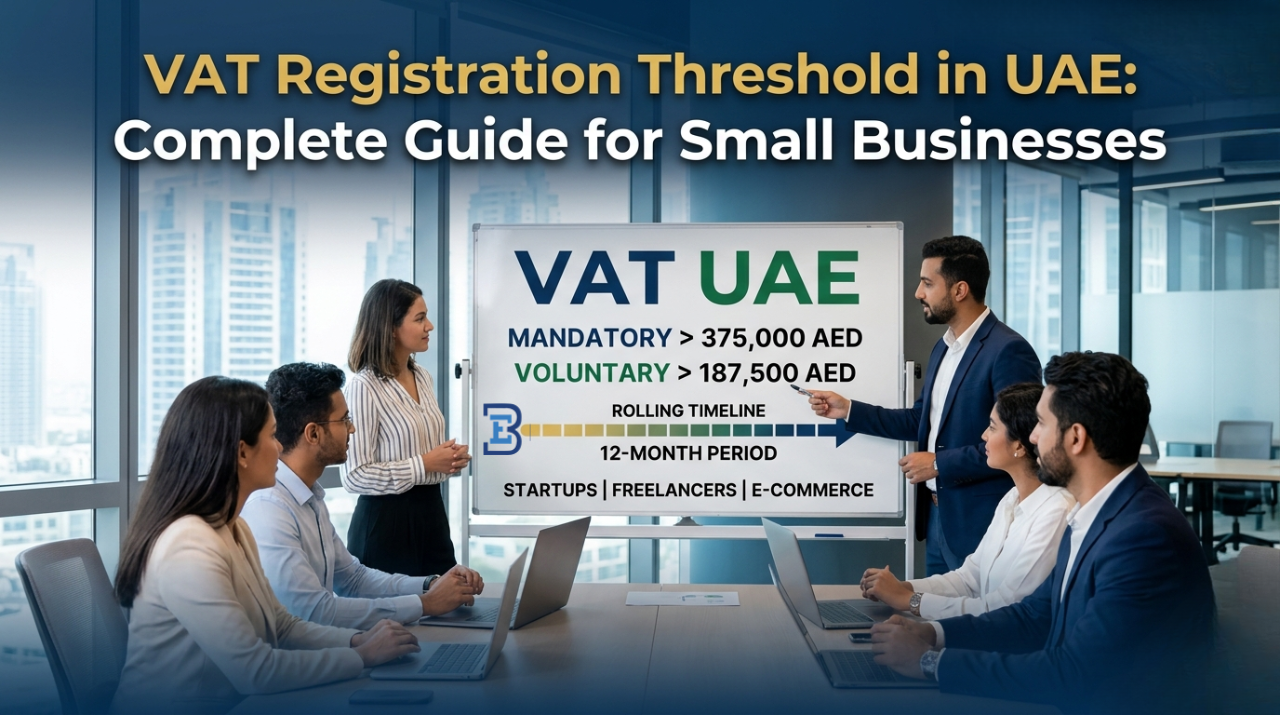
This guide delineates the Value Added Tax (VAT) compliance framework applicable to all commercial entities operating within the United Arab Emirates (UAE). Initially, it addresses a prevalent misconception among local business owners, contrary to the belief that VAT registration is contingent upon profitability, UAE regulations explicitly mandate that taxable turnover is the sole qualifying criterion.
Consequently, it is imperative for all start-ups, micro, small, and medium-sized enterprises (MSMEs), freelancers, consultants, e-commerce merchants, and growth-stage companies to thoroughly understand the VAT registration thresholds. Delayed registration exposes businesses to regulatory penalties, compliance disputes, and unnecessary financial liabilities. To mitigate these risks, this guide provides a comprehensive overview of registration thresholds, regulatory standards, applicable financial caps, and tailored compliance strategies for small businesses.
What Is VAT Registration?
Value-Added Tax (VAT) registration is the formal procedure through which an enterprise applies to the Federal Tax Authority (FTA) to secure a Tax Registration Number (TRN). This process legally entitles the business to charge VAT on taxable supplies and recover eligible input VAT. Following successful registration, enterprises are mandated to adhere to five specific core compliance obligations.
What Is the VAT Registration Threshold in UAE?
Under the Value-Added Tax (VAT) legislation of the United Arab Emirates (UAE), businesses are subject to mandatory VAT registration once the total value of their taxable supplies and imports exceeds AED 375,000. This obligation is triggered if the financial threshold has been surpassed during the preceding 12 months or is anticipated to be exceeded within the forthcoming 30 days. This regulatory requirement applies to most domestic enterprises across all industry sectors within the UAE.
What Is the Voluntary VAT Registration Threshold?
Under the value-added tax (VAT) framework of the United Arab Emirates (UAE), two specific categories of businesses with an annual revenue exceeding AED 187,500 are eligible to apply for voluntary registration. By registering, startups and expanding enterprises are able to recover VAT input on their qualifying business expenditures.
Criteria for VAT Registration
To determine their obligation to register for Value-Added Tax (VAT) in the United Arab Emirates (UAE), enterprises must evaluate three core metrics. First, they must assess taxable sales, which encompass domestic goods and services, zero-rated supplies, and compliant exports. Second, the value of VAT-liable imports must be incorporated into the registration threshold calculation. Third, organizations must monitor both historical and projected turnover, as mandatory registration is required if their turnover is anticipated to exceed the threshold within the next 30 days.
What Is Included in the VAT Registration Threshold Calculation?
When determining the value-added tax (VAT) registration threshold, the calculation must incorporate standard-rated supplies, zero-rated supplies, taxable imports, and specified cross-border transactions. Conversely, exempt supplies and out-of-scope transactions are strictly excluded. It is imperative to classify these items accurately, as any misclassification may result in penalties for delayed registration.
VAT Registration for Small Businesses
A prevalent misconception among owners of micro and small enterprises in the United Arab Emirates (UAE) is that value-added tax (VAT) registration is exclusively required for large corporations. In reality, mandatory VAT registration applies to any entity generating an annual taxable income exceeding 375,000 dirhams across five specific business categories, including e-commerce and consulting, irrespective of their actual profit levels.
Example of VAT Registration Threshold
Example 1
A digital marketing agency generates:
January to December revenue: AED 420,000
Since taxable turnover exceeds AED 375,000, VAT registration is mandatory.
Example 2
A startup expects to sign contracts worth AED 400,000 during the next month.
Even if historical turnover is below AED 375,000, registration becomes mandatory because the future threshold is expected to be exceeded within 30 days.
VAT Registration Limits Explained
There are effectively three categories:
Below AED 187,500
VAT registration is generally not required.
Between AED 187,500 and AED 375,000
Voluntary registration is available.
Above AED 375,000
VAT registration becomes mandatory.
Benefits of Voluntary VAT Registration
Many growing businesses choose voluntary registration because it allows them to:
-
Recover VAT on expenses
-
Improve business credibility
-
Work with larger corporate clients
-
Prepare for future growth
-
Establish VAT compliance processes early
Common Mistakes Businesses Make
Growth-stage enterprises that voluntarily register for Value-Added Tax (VAT) can successfully recover input VAT on their operational expenditures, enhance their corporate credibility, secure partnerships with major clients, prepare for future expansion, and proactively establish compliance protocols.
During the VAT registration process, however, enterprises frequently fall victim to five common misconceptions:
-
First, they mistakenly calculate the registration threshold based on a standard calendar year, rather than the mandated rolling 12-month period.
-
Second, they incorrectly exclude zero-rated supplies from their calculations, despite the requirement that these amounts be factored into the threshold assessment.
-
Third, they limit their business turnover reviews to the year-end, neglecting the necessity for continuous, year-round monitoring.
-
Fourth, they fail to account for future operating revenue projections, overlooking the fact that anticipated revenue meeting the threshold can also trigger mandatory registration requirements.
Furthermore, according to official tax guidelines, enterprises that delay their registration must retroactively remit all taxes owed from the exact date their registration obligation arose, and they may also be subject to severe administrative penalties.
How to Register for VAT in UAE
Value-Added Tax (VAT) registration with the United Arab Emirates' Federal Tax Authority (FTA) must be executed entirely through the authority's designated online platform. The procedure requires a systematic approach: establishing a portal account, completing the application form, uploading the requisite documentation, declaring business turnover figures, and acquiring a Tax Registration Number (TRN). Our team of bookkeeping professionals provides six specialized services for local enterprises, proactively addressing regulatory mandates to ensure full compliance and mitigate the risk of financial penalties.
Disclaimer
This article is intended for general informational purposes only and should not be considered tax, legal, or professional advice. VAT regulations and administrative practices may change. Businesses should seek professional guidance based on their specific circumstances before making registration or compliance decisions.
